 +91-120-4736400
 info@sphinxworldbiz.com


Is Your BIW Die Design Partner Ready for Your Next Automotive Programme?
A die design decision can influence much more than tooling development. It can affect component quality, material utilisation, production efficiency, engineering revisions and programme timelines.
For automotive OEMs and Tier 1 suppliers, selecting the right engineering partner is therefore a strategic decision.
As automotive manufacturers manage increasingly complex vehicle platforms, lightweight materials and demanding production schedules, many are evaluating specialist engineering companies in India for automotive stamping and BIW die design support.
But how do you identify a partner that can meet your engineering requirements rather than simply offer competitive pricing?
Before selecting a BIW die design company in India, evaluate these nine critical factors to understand whether the engineering team can support your manufacturing objectives, technical standards and long-term programmes.
What Is BIW Die Design in Automotive Manufacturing?
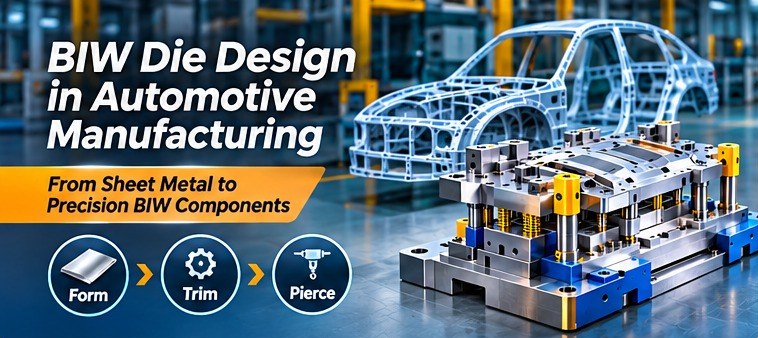
Body-in-White (BIW) die design is the engineering process of developing tooling used to form, shape, trim and pierce sheet metal components that make up an automotive vehicle body before final assembly and painting.
It involves designing dies that help manufacture components such as doors, roofs, pillars, floor panels, side panels and other structural body parts.
A well-engineered BIW die supports:
- Dimensional accuracy and repeatability.
- Consistent component quality.
- Efficient material utilisation.
- Reduced forming defects and rework.
- Reliable production processes.
- Better integration with manufacturing requirements.
For OEMs and Tier 1 suppliers, the objective is not simply to create a 3D die model. It is to develop a tooling design that considers component geometry, material behaviour, manufacturing feasibility and production requirements.
Why Are Global Automotive OEMs Evaluating BIW Die Design Companies in India?
Automotive engineering programmes require specialised design capabilities, experienced engineers and the flexibility to manage changing project requirements.
India has become an important engineering outsourcing destination because companies can access skilled CAD engineering teams and scalable delivery models.
However, outsourcing should not be based on cost alone.
A suitable engineering partner should demonstrate:
- Experience in automotive stamping and tooling design.
- Knowledge of OEM engineering requirements.
- Proficiency in relevant CAD and simulation platforms.
- Structured project management and quality processes.
- Ability to work with international engineering teams.
- Secure handling of technical data and intellectual property.
The right partner should integrate with your existing engineering workflow and deliver design outputs that support your manufacturing objectives.
9 Critical Factors to Evaluate Before Choosing a BIW Die Design Company in India
1. Evaluate Actual Automotive Die Design Experience
Not every CAD engineering company has the specialised experience required for automotive BIW die design.
Automotive stamping involves complex component geometry, material behaviour, forming requirements, tooling constraints and production considerations.
Before selecting a partner, evaluate its experience with:
- Automotive sheet metal components.
- Blank, draw, trim and pierce dies.
- Cam and forming dies.
- Progressive and transfer die concepts.
- Automotive press tooling.
- BIW component development.
Ask potential partners to demonstrate relevant engineering experience through approved project examples, sample deliverables and technical discussions.
What to ask: Has the engineering team worked on automotive stamping components and tooling projects with requirements similar to ours?
2. Check Expertise in CATIA V5 and Siemens NX
CAD software capability is an important consideration when selecting an automotive die design partner.
OEMs and Tier 1 suppliers often work within established engineering environments. Your partner should understand the platforms and data requirements used by your organisation.
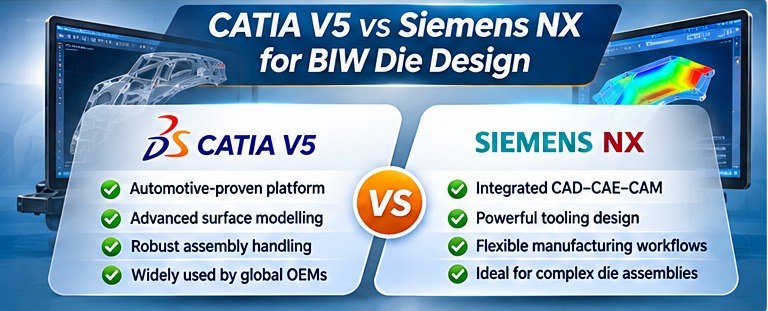
Two important platforms in automotive engineering are:
CATIA V5
CATIA V5 is widely used in automotive product development and engineering. It supports complex surface modelling, component design, assemblies and detailed engineering work.
Siemens NX
Siemens NX provides integrated capabilities for product design, engineering and manufacturing workflows, including tooling and die design.
The selection of software should depend on your OEM standards, project requirements, existing CAD environment and data exchange processes.
Sphinx Worldbiz reports more than 215 designs using CATIA V5 and 755 designs using Siemens NX on its BIW die design service page.
Explore the company’s BIW Die Design Services to understand its CAD and tooling engineering capabilities.
For further technical information, visit the official Siemens NX Stamping Die Design page.
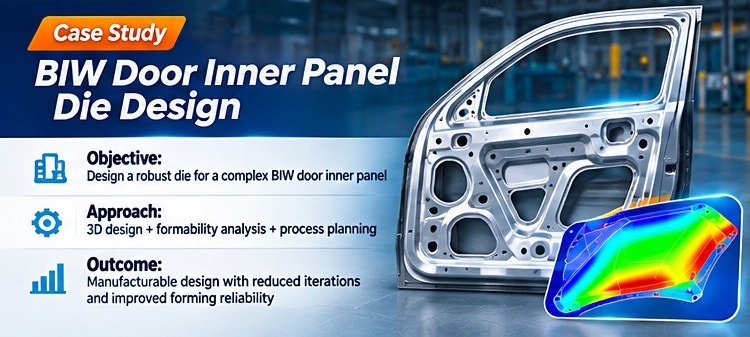
3. Evaluate Formability Analysis and Stamping Simulation Capabilities
A die design may look correct in CAD but still face challenges during actual forming.
Material thinning, wrinkling, tearing, springback and dimensional deviations can affect the quality of stamped components.
Formability analysis and stamping simulation help engineers evaluate potential issues before physical tooling trials.
A capable engineering partner should understand:
- Sheet metal material behaviour.
- Forming feasibility.
- Material flow and thinning.
- Wrinkling and tearing risks.
- Springback considerations.
- Multi-stage forming processes.
- Simulation-based design improvements.
Early identification of forming issues can help reduce avoidable design revisions and support more predictable tooling development.
For additional technical context, explore Ansys LS-DYNA Metal Forming.
4. Understand the 3D Process and Method Planning Approach
A reliable die design project starts with a structured process and method plan.
This stage helps determine how the component will be manufactured and which operations may be required.
Depending on component geometry and production requirements, the engineering team may evaluate:
- Component feasibility.
- Blank development.
- Draw operation planning.
- Trimming and piercing operations.
- Forming and flanging operations.
- Cam mechanism requirements.
- Tooling and press considerations.
An effective process plan connects product geometry with tooling design and manufacturing requirements.
Ask the engineering partner how it develops the process plan, validates feasibility and manages engineering changes.
5. Check Experience Across Different Types of Automotive Dies
Automotive stamping projects may require different die configurations depending on component geometry, production volume, press setup and manufacturing strategy.
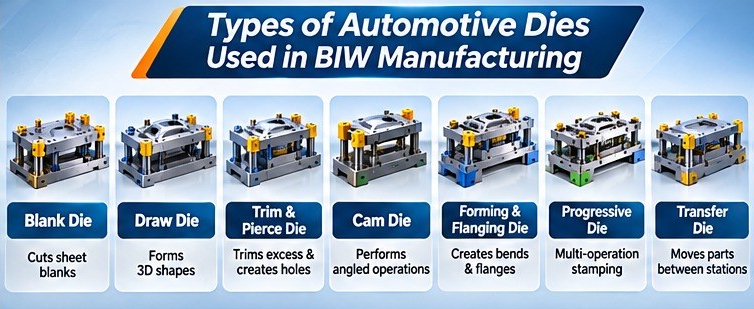
| Die Type | Primary Application |
|---|---|
| Blank Die | Cuts the required blank from sheet material |
| Draw Die | Forms sheet metal into the required component shape |
| Trim and Pierce Die | Removes excess material and creates required openings |
| Cam Die | Performs operations in directions other than the main press movement |
| Forming and Flanging Die | Creates bends, flanges and formed features |
| Progressive Die | Performs multiple operations through successive stations |
| Transfer Die | Moves components between multiple forming stations |
Your engineering partner should understand the design considerations associated with the die types relevant to your programme.
The right tooling approach depends on component complexity, production volume, press configuration and manufacturing constraints.
6. Evaluate Manufacturing and Press Line Integration
A technically detailed die design must also consider the manufacturing environment in which the tooling will operate.
Ignoring press and production constraints can create issues during tooling development, installation and production trials.
Evaluate whether your engineering partner understands:
- Press line specifications.
- Press capacity and operating requirements.
- Die dimensions and layout constraints.
- Material handling and transfer requirements.
- Press simulation and kinematics.
- Tool accessibility and maintenance considerations.
- Manufacturing documentation requirements.
Sphinx Worldbiz lists experience with different production configurations, including tandem press lines, Tri-Axis, robotic and crossbar systems.
The objective is to ensure that the die design aligns with the customer’s manufacturing setup and project specifications.
7. Review Engineering Quality, Validation and Documentation
Quality should be evaluated throughout the engineering process, not only after the design is completed.
Before appointing a BIW die design partner, understand how the company manages design reviews, technical validation, engineering changes and documentation.
Important deliverables may include:
- 3D die design models.
- 2D technical drawings.
- Assembly and component details.
- Process and method plans.
- Simulation reports, where included in scope.
- Engineering change documentation.
- Design review records.
- Manufacturing-related technical documentation.
Clarify the required CAD formats, drawing standards, revision controls and customer-specific quality procedures before starting the project.
8. Assess Engineering Capacity and Project Scalability
Automotive programmes can involve changing workloads, tight schedules and multiple engineering activities running simultaneously.
A suitable engineering partner should be able to support the project scope without compromising quality or communication.
Evaluate:
- Availability of experienced die design engineers.
- Ability to scale teams according to project demand.
- Project management structure.
- Engineering review and escalation processes.
- Delivery milestones and reporting.
- Offshore, onshore or hybrid collaboration options.
Do not evaluate a supplier only by its current team size. Understand how it will manage your actual project workload and future engineering requirements.
9. Prioritise Communication, Data Security and IP Protection
Automotive engineering projects involve sensitive product data, component specifications, design files and manufacturing information.
A reliable engineering partner should have clear procedures for protecting customer information and managing project communication.
Before signing an agreement, discuss:
- Confidentiality and NDA requirements.
- Intellectual property ownership.
- Secure file transfer and data access.
- Project communication channels.
- Engineering change approvals.
- Documentation and revision control.
- Customer-specific information security requirements.
Clear communication and defined responsibilities help reduce misunderstandings during complex engineering programmes.
BIW Die Design vs BIW Fixture Design: What Is the Difference?
BIW die design and BIW fixture design are related automotive engineering disciplines, but they serve different manufacturing purposes.
| Parameter | BIW Die Design | BIW Fixture Design |
|---|---|---|
| Primary Purpose | Forms and shapes sheet metal components | Positions, locates and holds components |
| Manufacturing Stage | Stamping and forming | Welding and assembly |
| Main Equipment | Dies and press tooling | Jigs, fixtures and checking equipment |
| Key Considerations | Formability, material flow and tooling geometry | Location, clamping, alignment and repeatability |
| Main Output | Stamped automotive body components | Accurately positioned components for assembly |
For manufacturers looking for support across both disciplines, explore BIW Fixture Design Services.
You can also read our related guide: Looking for a BIW Fixture Design Company in India? 7 Critical Factors Global Automotive OEMs Must Evaluate.
What Does a Complete BIW Die Design Workflow Look Like?
A structured engineering workflow helps connect component requirements with tooling design and manufacturing expectations.
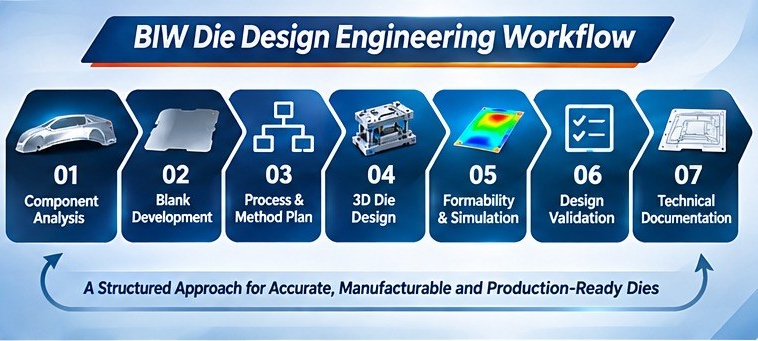
A typical workflow includes seven stages:
Stage 1: Component and Requirement Analysis
Review component geometry, material specifications, production requirements and customer standards.
Stage 2: Feasibility and Blank Development
Evaluate forming feasibility and develop the blank concept according to component and manufacturing requirements.
Stage 3: Process and Method Planning
Define the sequence of operations, tooling concepts and manufacturing approach.
Stage 4: 3D Die Design
Develop detailed 3D tooling models using the CAD platform specified by the customer.
Stage 5: Formability Analysis and Simulation
Evaluate potential forming issues and review the design against relevant simulation requirements.
Stage 6: Engineering Validation and Design Review
Review design outputs, incorporate feedback and address identified engineering issues.
Stage 7: Technical Documentation and Final Delivery
Prepare agreed 3D models, 2D drawings, documentation and other project deliverables.
The actual workflow and deliverables should be agreed with the customer at the beginning of each project.
India vs Germany vs USA: Where Should Automotive OEMs Outsource BIW Die Design?
Choosing an engineering outsourcing destination requires evaluating more than hourly engineering costs.
| Evaluation Factor | India | Germany | USA |
|---|---|---|---|
| Engineering Talent | Large engineering talent pool | Strong automotive engineering ecosystem | Strong engineering and technology ecosystem |
| Outsourcing Model | Offshore, onshore and hybrid options | Local and regional engineering partnerships | Domestic and global outsourcing options |
| Cost Considerations | Often competitive for offshore engineering | Generally higher operating costs | Generally higher operating costs |
| Collaboration | Requires structured cross-border coordination | Often convenient for European programmes | Often convenient for North American programmes |
| Supplier Selection | Evaluate technical expertise, quality and scalability | Evaluate automotive specialisation and project fit | Evaluate technical capability and programme alignment |
There is no universally best destination for every automotive programme.
The right decision depends on engineering complexity, OEM standards, programme location, communication requirements, cost structure and supplier capabilities.
India can be a suitable engineering destination when the selected partner demonstrates the technical expertise, delivery processes and project management capabilities required by the customer.
Why Consider Sphinx Worldbiz for BIW Die Design Services?
Selecting an engineering partner requires evidence of technical capability, relevant experience and an understanding of automotive manufacturing requirements.
Sphinx Worldbiz provides engineering design and product development services to customers across international markets.
Its published BIW die design capabilities include:
- 3D automotive stamping die design.
- CATIA V5 and Siemens NX-based engineering.
- Simulation and formability analysis.
- 3D process and method planning.
- Cam and press simulation.
- 2D technical drawings.
- Different automotive die configurations.
The company’s BIW die design service page reports:
- 29+ years of engineering experience.
- 215+ designs using CATIA V5.
- 755+ designs using Siemens NX.
These are company-published figures and should be considered alongside project-specific experience, technical reviews and customer requirements.
Explore the complete BIW Die Design Services offered by Sphinx Worldbiz.
For broader engineering capabilities, you can also explore:
Looking for a BIW Die Design Engineering Partner?
Your next automotive programme deserves an engineering partner that understands tooling design, manufacturing requirements and engineering collaboration.
If your organisation is evaluating BIW die design support for an upcoming vehicle programme, connect with Sphinx Worldbiz to discuss your component requirements, CAD environment, project scope and delivery expectations.
Discuss Your BIW Die Design Requirements with Sphinx Worldbiz
Frequently Asked Questions About BIW Die Design Companies in India
1. What does a BIW die design company do?
A BIW die design company develops tooling designs used to manufacture automotive sheet metal body components. Its work may include blank, draw, trim, pierce, cam, forming and flanging die design, along with process planning, simulation and technical documentation.
2. How do I choose the right BIW die design company in India?
Evaluate the company’s automotive die design experience, CAD software expertise, formability analysis capabilities, engineering quality processes, project scalability, communication practices and data security procedures. Ask for relevant project examples and clearly defined deliverables.
3. Which software is used for automotive BIW die design?
CATIA V5 and Siemens NX are important CAD platforms used in automotive engineering and tooling design. Other tools may be used for stamping simulation, formability analysis and manufacturing validation depending on the customer’s engineering environment.
4. What are the main types of BIW dies?
Common automotive die types include blank dies, draw dies, trim and pierce dies, cam dies, forming and flanging dies, progressive dies and transfer dies. The selection depends on component geometry and manufacturing requirements.
5. Why is formability analysis important in BIW die design?
Formability analysis helps evaluate how sheet metal behaves during forming. It can help identify potential issues such as material thinning, wrinkling, tearing and springback before tooling reaches physical trials.
6. What is the difference between BIW die design and BIW fixture design?
BIW die design focuses on forming and shaping sheet metal components through stamping operations. BIW fixture design focuses on accurately positioning and holding components during welding, joining and assembly operations.
7. Can automotive OEMs outsource BIW die design to India?
Yes. Automotive OEMs and Tier 1 suppliers can outsource BIW die design activities to engineering companies in India. Supplier selection should consider technical expertise, CAD compatibility, quality processes, data security and the ability to meet programme requirements.
8. What deliverables should I expect from a BIW die design partner?
Depending on the project scope, deliverables may include 3D CAD models, 2D technical drawings, process and method plans, simulation reports, assembly details and engineering documentation.
9. How long does a BIW die design project take?
Project timelines depend on component complexity, the number of operations, tooling requirements, design scope and customer review cycles. A simple die may take a few weeks, while complex multi-stage tooling programmes may require several months.
10. What factors affect BIW die design costs?
Costs depend on component geometry, material specifications, tooling complexity, number of operations, engineering hours, simulation requirements, documentation and project timelines. A reliable quotation should be based on a clearly defined technical scope.
11. Does Sphinx Worldbiz provide CATIA V5 and Siemens NX die design services?
Sphinx Worldbiz lists CATIA V5 and Siemens NX among its BIW die design capabilities. Its service page reports more than 215 CATIA V5 designs and 755 Siemens NX designs.
12. How can I discuss a BIW die design project with Sphinx Worldbiz?
You can contact Sphinx Worldbiz through its official contact page to discuss component details, CAD requirements, project scope and engineering support.
Conclusion: Choose an Engineering Partner That Understands More Than CAD
A successful BIW die design project requires more than software proficiency. It demands automotive tooling knowledge, process planning, formability understanding, engineering validation and coordination with manufacturing requirements.
For global automotive OEMs and Tier 1 suppliers evaluating engineering partners in India, these nine factors provide a practical framework for comparing technical capability and project readiness.
Before making your next outsourcing decision, evaluate the engineering process, review relevant project experience and establish clear technical expectations.
Looking for a BIW Die Design Company in India?
Connect with Sphinx Worldbiz to discuss your automotive die design and engineering requirements.
Explore: BIW Die Design Services
