 +91-120-4736400
 info@sphinxworldbiz.com


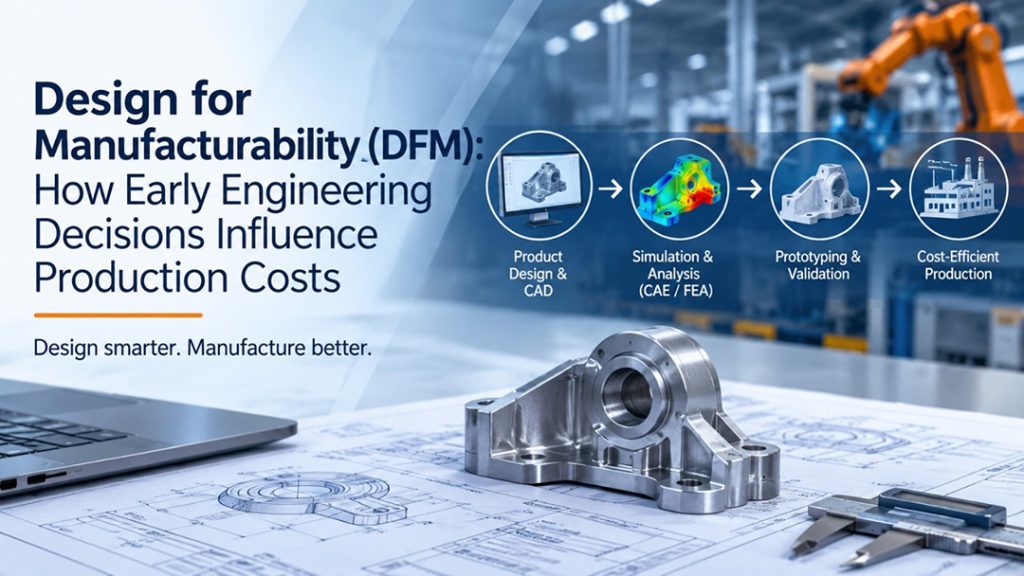
Manufacturing costs are not determined on the factory floor alone. Many of the factors that influence production expenses, product quality, assembly time, and manufacturing efficiency are established much earlier during the product design and engineering stages.
A component may look technically sound in a CAD model, but can it be manufactured consistently? Is the selected material suitable for the intended application? Can the design be assembled without unnecessary complexity? Will the chosen manufacturing process support the required production volume?
These are the questions that Design for Manufacturability (DFM) aims to address.
For European manufacturers operating in increasingly competitive markets, DFM is an important consideration in building cost-effective, production-ready products. By integrating manufacturing requirements into the early stages of product design and development, businesses can identify potential production challenges before they become expensive engineering changes.
What Is Design for Manufacturability (DFM)?
Design for Manufacturability (DFM) is an engineering approach that considers manufacturing capabilities, material properties, production processes, assembly requirements, and cost constraints while designing a product.
Instead of treating product design and manufacturing as separate activities, DFM brings them together to make sure that a product is not only functional and reliable but also practical and economical to manufacture.
A well-planned DFM process evaluates:
- Material selection and availability.
- Component geometry and design complexity.
- Manufacturing process compatibility.
- Assembly requirements and part standardization.
- Manufacturing tolerances and quality requirements.
- Production volume and tooling considerations.
The objective is to reduce avoidable design complexity, minimize rework, and improve the transition from engineering design to production.
Five Engineering Decisions That Directly Influence Manufacturing Costs
The decisions made during product development can have a considerable influence on the resources and processes required for manufacturing. Here are five areas where engineering teams should pay particular attention.
1. Material Selection: Balancing Performance, Cost and Manufacturability
Material selection involves more than choosing a material that meets a product’s strength, weight, or durability requirements. Engineers must also consider how easily it can be processed, formed, machined, joined, and finished.
For example, selecting lightweight material may improve product performance, but its machining requirements, forming limitations, joining methods, and availability could affect overall production costs.
A structured material selection and optimization process should consider:
- Mechanical and thermal properties.
- Material availability and procurement costs.
- Compatibility with manufacturing processes.
- Weight, durability, and lifecycle requirements.
- Scrap generation and material utilization.
Early material evaluation helps engineering teams balance product performance with production feasibility rather than discovering material-related limitations after design completion.
2. Design Complexity: Simplifying Components Without Compromising Functionality
Complex product geometry can introduce additional manufacturing steps, specialized tooling, difficult machining operations, and tighter process controls.
In some cases, a design can achieve the same functional objective through a simpler component structure or a more practical geometry.
Through 3D CAD modelling, design reviews, and engineering analysis, teams can identify opportunities to simplify components while retaining essential functional and performance requirements.
Considerations include:
- Reducing unnecessary geometric features.
- Avoiding unnecessarily complex component configurations.
- Standardizing components wherever practical.
- Reviewing wall thickness, draft angles, and feature accessibility.
- Evaluating design changes against functional requirements.
The goal is not to make every design simple. The goal is to ensure each design feature serves a purpose and can be manufactured efficiently.
3. Assembly Design: Reducing Complexity Across the Production Process
A product with individually manufacturable components may still create challenges during final assembly.
Excessive fasteners, difficult component access, complicated joining requirements, and poor part orientation can increase assembly time and introduce opportunities for errors.
This is where Design for Assembly (DFA) complements DFM.
Engineering teams can evaluate:
- Opportunities to reduce unnecessary component count.
- Standardization of fasteners and joining methods.
- Ease of component positioning and accessibility.
- Assembly sequence and handling requirements.
- Possibilities for automation and repeatability.
An effective DFM and DFA approach considers how components will be manufactured and how they will come together as a complete product.
4. Tolerances and Validation: Preventing Manufacturing Issues Before Production
Dimensional tolerances directly influence how accurately components must be manufactured and how consistently they fit during assembly.
Unnecessarily tight tolerances can increase machining requirements, inspection effort, and production complexity. Conversely, poorly defined tolerances can cause fitment problems, functional issues, and quality variations.
Engineering simulation, CAE analysis, and design validation help teams assess whether a proposed design meets its intended performance requirements.
Depending on the product and manufacturing process, engineers can use:
- Tolerance stack-up analysis.
- Finite Element Analysis (FEA).
- Formability and deformation assessment.
- Digital Design Reviews.
- Physical prototype testing and validation.
Identifying potential issues during engineering development allows teams to refine the design before committing to production tooling and manufacturing operations.
5. Manufacturing Process Selection: Designing Production Capabilities
A product’s manufacturing feasibility also depends on selecting appropriate production processes.
For example, sheet metal components, plastic parts, and complex assemblies require different engineering considerations. The design must account for the capabilities and limitations of the intended process.
Manufacturing process evaluation may involve:
- Sheet metal forming and stamping feasibility.
- Injection molding requirements.
- CNC machining and fabrication considerations.
- Die and tooling design.
- Assembly line requirements and production automation.
For automotive and industrial equipment manufacturers, manufacturing engineering plays an important role in connecting product design with production planning, tooling, and process feasibility.
The earlier these requirements are considered, the easier it becomes to identify potential constraints and prepare designs for production.
The Role of CAD, CAE and Prototyping in DFM
Modern engineering workflows use digital tools and physical validation to improve design decisions before production begins.
Computer-Aided Design (CAD) helps engineers develop detailed 2D and 3D product models, assess component geometry, and refine design specifications.
Computer-Aided Engineering (CAE) supports simulation and analysis to evaluate structural performance, material behavior, deformation, and other engineering requirements.
Rapid prototyping allows teams to evaluate physical designs, assess fitness and function, and identify modifications before progressing towards production.
When integrated into the product development lifecycle, these capabilities support a more informed design process.
However, digital validation and physical testing serve different purposes. Their use should be determined by the product’s complexity, performance requirements, manufacturing method, and validation needs.
Why European Manufacturers Should Consider DFM Earlier in Product Development
European manufacturers across automotive, industrial machinery, energy, and consumer goods face increasing pressure to improve operational efficiency while maintaining product quality and performance.
DFM provides an opportunity to address manufacturing constraints during engineering development rather than relying exclusively on corrective actions during production.
For organizations developing complex products or managing multiple engineering programs, an early focus on manufacturability can support:
- Better coordination between design and manufacturing teams.
- More informed material and process decisions.
- Improved production readiness.
- Reduced risk of late-stage design modifications.
- More efficient use of engineering and manufacturing resources.
DFM should therefore be treated as an ongoing engineering consideration, not simply a final design approval activity.
How Sphinx Worldbiz Supports Design and Manufacturing Engineering
At Sphinx Worldbiz, product design and manufacturing engineering capabilities support businesses across the product development lifecycle, from concept development and detailed engineering to prototyping, simulation, and manufacturing-oriented design.
Our engineering capabilities include:
- Product Design and Development: Concept development, detailed design, CAD modelling, and engineering support.
- Simulation and Analysis: Engineering simulation, FEA modelling, formability analysis, and design validation.
- Rapid Prototyping: Physical prototypes to evaluate design feasibility, fit, function, and performance.
- Manufacturing Engineering: BIW fixture design, die design, process planning, and robotics simulation.
- Value Engineering: Design optimization, product benchmarking, standardization, and cost-focused engineering improvements.
With more than 30 years of engineering experience and a global delivery presence, Sphinx Worldbiz supports organizations seeking to strengthen their product development and manufacturing engineering capabilities.
The objective is to connect engineering decisions with practical manufacturing requirements, helping businesses move towards more efficient and production-ready product designs.
Final Thoughts: Manufacturing Efficiency Starts at the Design Stage
A cost-effective product is not simply one that uses inexpensive materials or fewer components. It is one where performance, design complexity, manufacturability, assembly, and production requirements have been considered together.
By integrating Design for Manufacturability, Design for Assembly, CAD/CAE, simulation, and prototyping into product development, engineering teams can make more informed decisions before production commitments are made.
For manufacturers, the question is no longer just whether a product can be designed. It is whether that product can be manufactured efficiently, consistently, and of the required quality.
Are your product designs being evaluated for manufacturability early enough, or are production challenges still being discovered after the design is finalized?
Share your perspective in the comments.
Frequently Asked Questions
What is the primary objective of Design for Manufacturability?
The primary objective of Design for Manufacturability is to optimize product designs for efficient production by considering material selection, component geometry, manufacturing processes, assembly requirements, and production costs during the design stage.
How does DFM help reduce manufacturing costs?
DFM helps reduce manufacturing costs by identifying unnecessary design complexity, improving material utilization, simplifying assembly, and addressing potential production issues before manufacturing begins.
What is the difference between DFM and DFA?
DFM focuses on making individual components easier and more economical to manufacture, whereas Design for Assembly (DFA) focuses on simplifying the process of joining components into a finished product.
What role do CAD and CAE play in Design for Manufacturability?
CAD helps engineers refine product design and development work, while CAE supports simulation and engineering analysis to assess performance, identify potential design issues, and improve manufacturing feasibility.
