+91-120-4736400
 info@sphinxworldbiz.com


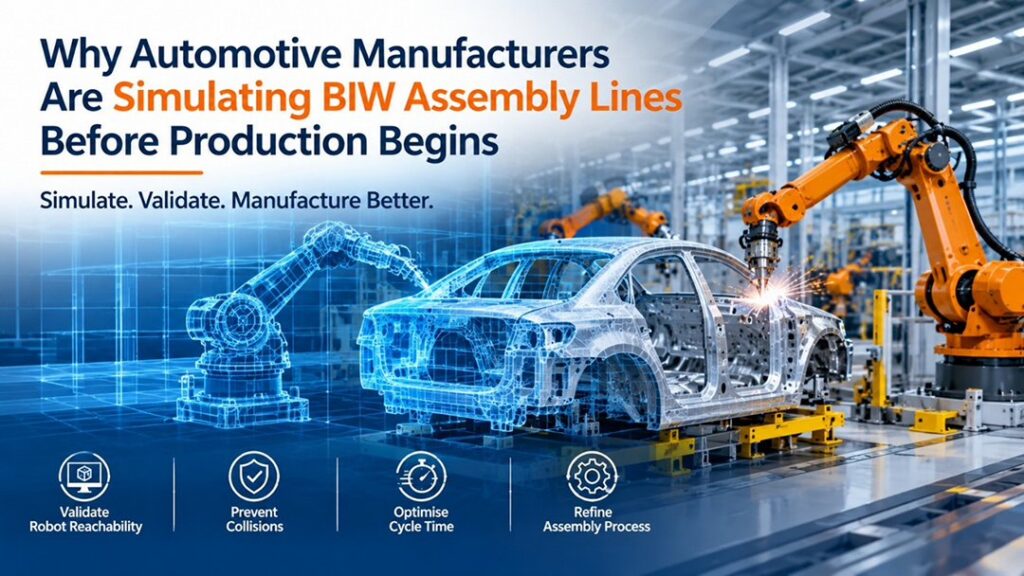
Automotive manufacturing is becoming increasingly complex. Vehicle platforms are evolving, production lines need to accommodate multiple models, and manufacturers are under constant pressure to improve production efficiency without compromising quality or delivery timelines.
In this environment, planning an automotive assembly line involves much more than selecting robots and positioning equipment. Engineers must evaluate robot movements, welding sequences, tooling accessibility, collision risks, production cycle times, and interactions between multiple robotic systems before physical implementation begins.
This is where robotic simulation plays an important role.
By creating a virtual representation of manufacturing operations, automotive manufacturers can evaluate production processes, validate robotic workcells, identify engineering constraints, and optimize automation workflows before deploying physical equipment.
For Body-in-White (BIW) manufacturing, where multiple robots perform coordinated welding, handling, positioning, and assembly operations, simulation provides an opportunity to identify potential issues during the engineering stage rather than discovering them after installation.
For European automotive OEMs and Tier 1 suppliers, adopting simulation-driven manufacturing engineering can support more informed production planning, improved automation feasibility, and better coordination between engineering and manufacturing teams.
What Is Robotic Simulation in Automotive Manufacturing?
Robotic simulation is the process of creating and analyzing virtual environments that represent industrial robots, production equipment, tooling, workpieces, and manufacturing operations.
Engineers use specialized simulation software to study robot movements, evaluate working envelopes, identify potential collisions, validate process sequences, and estimate production cycle times.
In automotive manufacturing, robot simulation is particularly useful for planning automated assembly lines where multiple industrial robots perform different operations within limited production spaces.
A typical robotic simulation workflow may include:
- Developing a virtual representation of the manufacturing cell.
- Positioning robots, fixtures, tools, and production equipment.
- Evaluating robot reachability and joint configurations.
- Simulating welding, material handling, and assembly operations.
- Identifying collision risks between robots and surrounding equipment.
- Analyzing robot trajectories and production cycle times.
- Validating process sequences before physical implementation.
The outcome is a more informed understanding of how the proposed automation system is expected to operate.
Rather than relying entirely on physical trials, engineering teams can evaluate several production scenarios within a virtual environment and refine the design before moving towards implementation.
What Is Body-in-White (BIW) Assembly?
Body-in-White (BIW) refers to the stage of automotive manufacturing where the vehicle’s main body structure is assembled before painting and final assembly.
At this stage, individual stamped metal components and structural parts are joined to create the vehicle body. These operations commonly involve spot welding, arc welding, riveting, clinching, and other joining technologies.
A typical BIW production environment includes:
- Robotic welding stations.
- Assembly fixtures and locating systems.
- Material handling equipment.
- Robotic grippers and welding guns.
- Conveyor systems and transfer mechanisms.
- Automated inspection and quality control equipment.
Modern BIW assembly lines often use multiple robots operating simultaneously to perform different joining and handling operations.
This creates several engineering considerations. Robot movements must be coordinated, welding tools need adequate access, fixtures must hold components accurately, and equipment must operate without interference.
BIW assembly simulation helps engineering teams evaluate these requirements within a virtual manufacturing environment before committing to physical cell installation.
Why Do Automotive Manufacturers Need BIW Assembly Simulation?
Planning an automated BIW assembly line without adequate simulation can leave several production-related questions unanswered.
Will every robot reach its assigned welding locations? Can multiple robots operate without interfering with one another? Is the proposed welding sequence practical? Will the production cycle time meet the required target?
These questions have direct implications for automation feasibility and production planning.
Here are five important areas where automotive assembly line simulation supports better engineering decisions.
1. Robot Reachability and Positioning: Ensuring Every Operation Is Feasible
Robot reachability is one of the first considerations when designing an automated manufacturing cell.
Every industrial robot has a defined working envelope determined by its mechanical configuration, arm length, joint limits, payload, and mounting position.
If a robot cannot reach a required welding point or assembly location in a suitable configuration, engineers may need to reconsider its position, orientation, tooling, or assigned operation.
Through robot reachability analysis, engineering teams can evaluate:
- Whether the robot can access all required process locations.
- Whether the selected robot configuration is suitable for the operation.
- Whether mounting positions provide sufficient working coverage.
- Whether tooling and workpiece orientations create accessibility constraints.
- Whether robot joint limitations affect the proposed movement sequence.
For example, in a BIW welding cell, a robot may need to access multiple welding points across a vehicle body structure. A poorly planned robot position could restrict access to certain locations or require unnecessary movements.
Virtual evaluation helps identify these constraints while the cell design can still be modified.
2. Welding Sequence Validation: Planning Robotic Joining Operations
Welding is a fundamental activity in BIW manufacturing. The sequence in which welding operations are performed can influence accessibility, equipment coordination, and production cycle time.
Robotic welding simulation allows engineers to evaluate how welding robots approach, position, and execute assigned operations.
This is particularly important when several robots operate within the same assembly cell.
Engineering teams can assess:
- Welding gun accessibility and orientation.
- Robot approach and withdrawal movements.
- Clearance around fixtures and vehicle body components.
- Coordination between multiple welding robots.
- Sequence feasibility and potential interference.
- Tooling requirements for different welding operations.
For instance, two robots working on opposite sides of a vehicle body may require carefully planned sequences to avoid overlapping working areas.
Robotic welding simulation helps evaluate these operations before the equipment is installed, allowing engineers to identify potential interference and refine the proposed process.
The same principles can also be applied to MIG welding, stud welding, clinching, riveting, and other robotic joining applications, depending on the manufacturing requirements.
3. Robot Collision Detection: Preventing Interference Between Equipment
In a complex automotive assembly cell, robots do not operate in isolation.
Their movements may bring them close to other robots, fixtures, welding guns, grippers, conveyors, safety equipment, and vehicle body components.
Even when individual robots can perform their assigned operations, their combined movements may introduce collision risks.
Robot collision detection helps identify these potential conflicts during simulation.
Engineers can evaluate:
- Robot-to-robot interference.
- Robot-to-fixture collisions.
- Tooling and welding gun clearance.
- Workpiece and equipment interference.
- Potential conflicts during approach and withdrawal movements.
- Clearance during coordinated robotic operations.
Consider a BIW cell where two robots are assigned welding operations on adjacent vehicle body sections. Both robots may have sufficient individual reachability, but their movement paths could overlap during simultaneous operations.
Simulation helps engineers study these interactions and adjust robot positions, paths, or process sequences where required.
Identifying these issues before physical implementation can reduce avoidable engineering modifications during installation and commissioning.
4. Robot Path Optimization: Improving Movement Efficiency
Robot path planning is not simply about ensuring that a robot reaches a particular point. The movement between operations also needs to be considered.
Unnecessary travel, inefficient approach angles, excessive repositioning, and poorly coordinated movements can increase the time required to complete a production cycle.
Robot path optimization helps engineering teams evaluate alternative trajectories and improve the movement sequence within a robotic cell.
The process may involve:
- Reviewing approach and retreat positions.
- Reducing unnecessary robot movements.
- Evaluating alternative robot configurations.
- Optimizing travel between process locations.
- Reviewing movement speed and acceleration constraints.
- Coordinating trajectories across multiple robots.
For example, a robot performing several welding operations may follow a longer-than-necessary path because of the original process sequence or positioning arrangement.
By reviewing alternative paths through simulation, engineers can identify opportunities to improve movement efficiency while maintaining the required process constraints.
However, path optimization must consider more than distance. Joint limitations, singularities, tooling clearance, welding requirements, and safe robot motion also need to be evaluated.
5. Robot Cycle Time Optimization: Aligning Automation with Production Targets
Production cycle time is an important consideration when planning automotive manufacturing operations.
A robotic cell may perform all its assigned operations successfully, but if the total cycle time exceeds the production target, the proposed automation concept may require further optimization.
Robot cycle time optimization involves analyzing the time required to complete the assigned operations and identifying activities that create unnecessary delays.
Simulation can help evaluate:
- Individual robot operation times.
- Waiting time between coordinated operations.
- Robot movement and repositioning time.
- Process sequencing and task allocation.
- Interactions between robots and transfer systems.
- Opportunities for parallel operations.
For example, when multiple robots work on the same BIW structure, some operations may be performed simultaneously while others require a specific sequence.
A simulation-based cycle-time study can help engineers understand these dependencies and evaluate alternative process arrangements.
The objective is to develop a production sequence that meets the required cycle time without compromising process feasibility, equipment constraints, or product quality.
What Is the Role of Offline Robot Programming in BIW Assembly?
Offline Robot Programming (OLP) allows engineers to create and refine robot programs in a virtual environment rather than relying exclusively on programming directly on the physical production line.
It is an important part of simulation-driven automotive manufacturing because it connects virtual process planning with robot-specific programming requirements.
Using offline robot programming, engineering teams can:
- Develop robot motion paths within simulation software.
- Define approach, process, and retreat positions.
- Evaluate robot movements against cell constraints.
- Check potential collisions and accessibility issues.
- Review program sequences before deployment.
- Validate robot programs using appropriate controller-specific simulation or RCS tools.
For automotive manufacturers, OLP can help move programming and process validation activities earlier in the engineering lifecycle.
It can also reduce dependence on physical robot availability during certain programming and validation activities.
However, virtual validation does not eliminate the need for physical commissioning. Robot programs still require appropriate controller checks, safety validation, calibration, and on-site verification before production use.
How Does Robotic Cell Design Influence BIW Production Efficiency?
A robotic cell is a coordinated manufacturing environment containing robots, fixtures, tools, safety systems, workpieces, and supporting equipment.
Its design influences how efficiently individual manufacturing operations can be performed.
Effective robotic cell design requires engineers to consider the complete working environment rather than evaluating robots individually.
Important design considerations include:
Robot positioning: Selecting suitable robot locations and mounting orientations to provide the required working coverage.
Tooling accessibility: Ensuring welding guns, grippers, and other end-effectors can access their assigned operations.
Equipment clearance: Maintaining adequate clearance between robots, fixtures, workpieces, and surrounding equipment.
Material flow: Evaluating how components enter, move through, and exit the production cell.
Operator accessibility: Considering maintenance access, equipment servicing, and operator safety requirements.
Production flexibility: Evaluating whether the cell can accommodate different product variants or future process changes.
Simulation allows engineers to examine these factors together and assess the feasibility of the proposed manufacturing arrangement.
How Robotic Simulation Supports the Automotive Production Planning Lifecycle
Robotic simulation is most useful when integrated into the broader manufacturing engineering process.
Instead of treating it as an isolated activity, manufacturers can incorporate virtual validation into several stages of production planning.
| Engineering stage | Role of robotic simulation |
| Concept planning | Evaluate automation feasibility and preliminary cell concepts. |
| Process planning | Define assembly sequences, robot operations, and production requirements. |
| Cell design | Assess robot positioning, reachability, tooling, and equipment clearance. |
| Process simulation | Validate robot movements, welding operations, and process sequences. |
| Offline programming | Develop and review robot programs in a virtual environment. |
| Cycle-time analysis | Evaluate operation times and identify potential bottlenecks. |
| Pre-implementation validation | Review simulation results and prepare for physical deployment. |
This integrated approach helps connect process planning, robotic engineering, tooling design, and production requirements.
It is particularly relevant for automotive manufacturers developing new BIW lines, modifying existing assembly cells, or introducing additional vehicle variants into established production facilities.
How Sphinx Worldbiz Supports BIW Assembly and Robotic Simulation
At Sphinx Worldbiz, robotics simulation capabilities support automotive manufacturers and engineering teams in planning, evaluating, and validating automated production processes.
Our approach brings together manufacturing process knowledge, robotic simulation, offline programming, and virtual engineering to address the practical requirements of automotive production environments.
Our key capabilities include:
1. BIW Assembly and Robotic Process Simulation
We support the simulation of BIW assembly processes, including robotic welding operations, assembly sequences, and manufacturing cell feasibility.
This helps engineering teams evaluate proposed production arrangements and identify potential process constraints.
2. Robotic Cell Design and Feasibility
Our engineering capabilities include 3D cell development, robot positioning, reachability assessment, tooling accessibility, and collision evaluation.
These activities help assess whether the proposed robotic configuration is suitable for the intended manufacturing operations.
3. Offline Robot Programming
We support offline robot programming and path development to evaluate robotic movements, process sequences, and controller-specific programming requirements.
The objective is to prepare and validate robot programs within the virtual engineering environment before physical deployment.
4. Cycle-Time and Robot Path Optimization
We evaluate robot trajectories, movement sequences, and coordination requirements to identify opportunities for improved cycle time and production efficiency.
5. Virtual Manufacturing and Simulation Preparation
Our capabilities also include process simulation, plant layout development, ergonomics assessment, and simulation cell preparation to support manufacturing engineering activities.
With more than 30 years of engineering experience and a global delivery presence, Sphinx Worldbiz combines engineering knowledge with digital manufacturing capabilities to support complex product and manufacturing development requirements.
Explore our robotic simulation services: https://www.sphinxworldbiz.com/robotics-simulation/
Frequently Asked Questions About Robotic Simulation in Automotive Manufacturing
1. What is BIW assembly simulation?
BIW assembly simulation is the virtual modelling and evaluation of robotic and manufacturing operations involved in assembling a vehicle’s Body-in-White structure. It helps engineers assess robot positioning, welding sequences, reachability, collision risks, and production cycle times before physical implementation.
2. Why is robotic simulation important in automotive manufacturing?
Robotic simulation helps automotive manufacturers evaluate production processes before installing physical automation equipment. It supports robot reachability studies, collision detection, process validation, robot path planning, and cycle-time analysis, helping engineering teams identify potential issues earlier.
3. What is the difference between robot simulation and offline robot programming?
Robot simulation is used to model and analyse robotic operations, including movement, reachability, collisions, and production cycle times. Offline robot programming involves developing robot programs within a virtual environment for subsequent validation and deployment on physical robots.
4. How does robotic simulation help reduce production downtime?
Robotic simulation allows engineers to evaluate and refine automation processes before physical implementation. By identifying potential collisions, access constraints, and inefficient movement sequences earlier, manufacturers can reduce avoidable modifications and troubleshooting during installation and commissioning.
5. What is robot reachability analysis?
Robot reachability analysis evaluates whether an industrial robot can access its assigned process locations within its mechanical working envelope and joint constraints. It helps engineers determine suitable robot positions, mounting configurations, and tooling arrangements.
6. How does collision detection work in robotic simulation?
Collision detection identifies potential interference between robots, tooling, fixtures, workpieces, and other equipment within a simulated manufacturing environment. Engineers use these results to review movement paths, positioning, and process sequences.
7. What is robot cycle-time optimization?
Robot cycle-time optimization involves analyzing robotic movements, process sequences, waiting periods, and coordination between multiple robots to identify opportunities to reduce the time required to complete manufacturing operations.
8. Can robotic simulation support electric vehicle manufacturing?
Yes. Robotic simulation can support EV manufacturing activities such as battery pack assembly, body structure joining, material handling, robotic welding, and automated production cell planning. Specific applications depend on the production process and automation requirements.
9. What should manufacturers consider when selecting a robotic simulation partner?
Manufacturers should evaluate the partner’s automotive manufacturing knowledge, BIW process understanding, robot simulation experience, offline programming capabilities, familiarity with simulation software, tooling expertise, and ability to work with existing engineering and production teams.
Conclusion: Better Automotive Production Starts with Better Engineering Decisions
Automotive manufacturing automation involves several interconnected engineering decisions. Robot positioning, welding sequences, tooling accessibility, movement coordination, and cycle-time requirements all influence how effectively a production line performs.
Addressing these requirements only after physical implementation can introduce avoidable engineering changes and production challenges.
Robotic simulation provides a way to evaluate these factors earlier by creating a virtual representation of the proposed manufacturing environment.
For automotive manufacturers, integrating BIW assembly simulation, robotic cell design, offline robot programming, and process validation into production planning can support more informed engineering decisions and better-prepared automation systems.
As automotive production continues to evolve, simulation-driven manufacturing engineering will remain an important part of designing flexible, efficient, and production-ready assembly environments.
Are your BIW assembly processes being validated virtually before production begins?